Sunday, 2 February 2014
Dark Side of Social Media


Facebook is the cause of 20% of today’s divorces.
I have heard this figure a few times and while I cannot confirm or deny this statistic it does make you think. Social Media is amazing, without it for some, life would not be the same, and others wouldn’t see a change. I am a user of various forms but can easily go without it for days or weeks at a time. Others are obsessed and fail to continue to live without checking Facebook hourly to find out what is going on in the world. Obsession, is not the worst thing that Social Media does to people.
If the figure mentioned at the start of this blog entry is even loosely close to the mark, Facebook is a curse. Myself, I doubt and cannot fathom how Facebook can even be considered a cause of anybody’s divorce. Facebook itself is not sending saucy messages to inappropriate people, it is the user. Facebook is an excuse. I live in the country and found out that a co-worker of mine has become divorced because of Facebook. As a reaction he has ‘encouraged’ his teenage daughter to delete her account. While it is a sad and unfortunate tale, Facebook cannot be blamed. The marriage must have been in a situation that allowed for her to move on.
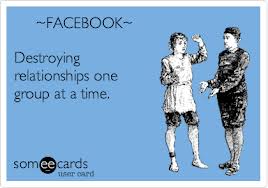
This unfortunately is not an uncommon story.
While divorce is the extreme in failed relationships there are others which also end with Facebook being a catalyst. Catfish, a popular MTV TV series, follows the investigation and first meeting between two people that have had a relationship online and have failed to meet. In most cases the ‘Catfish’ is not who they said they were, hence not meeting in the past. It is a sad and unsettling trend that meeting somebody online can be so dubious, and those who seek a partner and decide to follow the online route may be dragged through a long emotional journey fuelled by lies and deception for the other person’s gain.
Again however, Facebook or any other form of social media that is used to grow these relationships cannot be blamed and it is the users of these platforms taking advantage of others that are the real dark side of social media.
Sunday, 19 January 2014
Simulacra

In the early 2000’s I remember sitting in my bedroom, staring at my computer screen, ready to do my homework. But homework is boring and I really didn't want to do it. I’d have my word document open with a title written across the top of the page and my text book open looking up at me. “I've got time for a quick game” I’d say to myself. ALT-TAB into The Sims, my computer wasn’t very quick so even a quick play would take a while to load. I’d have my family of Sims walking around the house, mum and dad had to manage their jobs to the kids didn’t get taken away by the social worker, and I’d have to make sure they did all their homework so they got a good grade at Sim High… I wonder how many times I thought about how my grades were affected by not doing my real homework but only my Sim’s virtual homework.

Simulacra essentially means similarity or a representation. Move forward ten years or so from when I was playing the Sims there are many forms of digital media that give people an experience where they can represent themselves in their own way. Second Life is probably the most notable virtual world in which users can create themselves and live in a virtual world. Playstation Home is another which I came across a few years ago, and when I did I was perplexed. My mate showed me it and told me to look at how real it was, sure the graphics are great and the map is vast but I didn’t get it. He went on show me how he could interact with people and even buy clothes. This guy struggled pay check to pay check but proceeded to show me how he could spend $100 on a new T-shirt. I asked him if he would also get the shirt in the mail but he laughed and said “It’s only in the game mate”.

I think there is something about a virtual world that gives people a sense of freedom without restricting. Shy people are able to interact more easily, people who are embarrassed about their appearance are able to create a character without perceived flaws to show the ‘real’ side of them. For me there are limits, I still like to play the Sims, especially when I have homework to do, but I could never see myself spending real money on virtual clothes I will never be able to touch.
The video below is another from South Park, but it hits the mark.

Sunday, 12 January 2014
Politics

In this modern world politicians are using turning to more and more forms of media in order to spread their words of wisdom. In the United States of America, President Barack Obama has over 41 million followers. Closer to home former Prime Minister and social media fanatic Kevin Rudd has nearly 1.4 million followers is regularly seen taking 'selfies' with the youth of the nation. The main question is, does social media help politicians? Can it influence their popularity and lead to more votes or will it do more damage than good?

According to the Australian, Kevin Rudd has missed the mark. The article dated August 19th 2013, during Rudd's short second stint as Prime Minister, states that proximity is the key to a successful campaign stating that those physically closest to the candidate have the most influence. Some key statistics gathered from virtual focus groups listed social media low on the list of preferred sources for news on Australian politics.
83% Newspapers
81% ABC television
81% ABC radio
49% Commercial television
36% Blogs and non-mainstream media
31% Social media
One could argue that blogs form a part of social media, which would raise the figure above 31%, none the less, social media is not seen as a particularly favourable way to gather information about politics in Australia.

According to Gallup.com the figures do not paint help social media in the United States with the preferred news source being Television with 55% and Internet at only 21%, with only 2% coming from Facebook, Twitter and other social media.

So why do politicians insist on using social media? Thumbprintmarketinggroup.com believes it comes down to four reasons, worldwide reach, saving money, donations and trust.

These are all legitimate reasons and considering the ease and price of using social media, it seems stupid to not make use of what can be used as an essentially free marketing tool that gives wider and faster reach world wide then many other forms of media. Even 2%, for the costs involved, is worth using social media.

For politicians, much like businesses and and anybody else, social media can be a very beneficial and helpful tool, the key is to make sure that it is used correctly in order to have the best outcome. Taking a leap out of Mitt Romney's book and buying followers will no doubt cause more damage than good, and it might be a good idea to keep the number of selfies to a minimum to avoid targeting the wrong demographic for the party's policies.

Wikileaks


Wikileaks is a non-for-profit media organisation officially launched in 2007 by Julian Assange. Wikileaks has been subject to much criticism and has caused an ethical debate over the past six years due to the manner in which the information they have released was sourced and if the information should have been released at all. 
But what has Wikileaks done and why does everyone have an opinion on it? According to the Global Post a brief history of Wikileaks includes publishing Sarah Palin’s emails after Anonymous had hacked into her account, publishing a video of a helicopter attack that killing civilians and journalists, publishing information supplied by Bradley Manning, publishing 91,000 documents about the United State’s involvement in Afghanistan and publishing war logs; over 400,000 classified documents.

Simply put, given that the information obtained by Wikileaks was all done illegally so this list in itself seems to show that Wikileaks and Julian Assange are bad people. But looking into what the publication of these documents has achieved is where opinion begins to divide. Opinio Juris lists why the benefits out weight the dangers.

Firstly the bad: Diplomacy- the effects on diplomatic relationships due to the fact that government documents have been released in the past. Safety: the first batch of Wikileaks documents published failed to remove the names of informants. Transparency: there is a view that ordinary American’s know more than they need to know about the day to day goings on about the US government and military.
Now the Good: We have learned a lot about what has gone on in the war in the Middle East, the death of over 109,000 people including over 66,000 civilians by Iraqi and coalition forces. Security has been increased in many governments throughout the world to prevent hacking and future publication of documents.
So what do you think?
Is WikiLeaks evil or good?
For me, as a former military man myself I understand the power and necessity of ‘Need-to-Know’ information and only informing military members and the civilian population of information that is relevant and necessary. There are many things that I was involved in that I only needed to know the bare bones of the task. However in terms of safety and security, governments being hacked into is a danger that should have never been made possible and the fact that security has been enhanced is beneficial for everybody.


Sunday, 8 December 2013
Digital Activism


Digital activism is a concept that it not apparently clear to me upon first thinking about it. However upon pondering it quickly I can begin to understand the simplicity of the two words, digital and activism. Activism is not a new term or activity however much like everything else these days it has and is becoming more digitised, that is it is being expressed more openly on a worldwide and open forum such as social media. There are many activists who have been influential on a number of subjects throughout history, whether it be for peace, anti-war, freedom or anything else deemed a worthwhile cause. In the modern era activism is open much more broadly to anybody for any reason. Julian Assange and Occupy Wall Street are some examples of people or organisations taking to modern, digital technology to spread the word of their causes in order to achieve their goals. Julian Assange is someone who has been made very popular in various forms of media because of Wikileaks, I will discuss this in more detail in a later blog. Occupy Wall Street was a phenomenon aimed at ridding social and economic inequality. While now I cannot recall the exact end result I do remember how popular the movement was. Occupy Wall Street coined the term “We are the 99%”. A term that it was impossible not to see or hear for weeks, maybe even months after the protest first started. Like most protests however it was subject to criticism mainly drawn to the fact that the 99% they were claiming to be was an outdated and inflated figure. Luckily to good people at South Park were able to shed some humorous light on the matter and simplify it in this sort video.
 
But how did Occupy Wall Street use digital activism to get their message across? Organisations such as AdBusters and Anonymous were used to spread the word using their pre-existing worldwide member base to inform those with similar view as to what was thought, desired and planned. Both of these organisations use an array of social media and other digital technology to send their messages across. Digital activism is still relatively young, and while there are organisations such as AdBusters and Anonymous around, any issue be it important or not, as the possibility to be made public should there be enough interest in the subject matter.

Saturday, 7 December 2013
Twitter for Business

Many business big and small have found a voice using various forms of social media. Twitter is one of the most prominent and with over 550 million active users it is an easy way to reach out. Businesses have found many different methods of connecting with their followers, to raise brand awareness, announce new and upcoming products or even just entertain with interesting facts of figures about their industry. The most successful businesses have found a balance of letting their followers know about what they are doing but also engaging with them on a personal level. In recent times twitter has developed into a customer service tool which depending on how well and quickly it is done can have positive or negative effects to the brand. By responding positively and quickly to customer complaints or queries, not only is the asker satisfied, but the brands whole following is also able to see how well they have dealt with the issue and potentially answering a question many other also have. Alternatively, not issuing a response or not making an effort to satisfy or rectify the issue is also seen by the entire following which will have negative results.
Twitter lists a number of success stories on their business site. By use of ‘promoted tweets’, essentially an ad dressed as a tweet that shows up on the twitter feed of anybody who fits into your demographic, businesses are able to expand their reach and use twitter to enhance areas of their business, be it visitors to their website, more online sales or just extra twitter followers. Bigger brands too have found success with many finding large followings. The image below (link) shows the 25 most engaged brands out of the largest 100 followings. As stated on the right, the 10 most prolific content creators were not on the list of most engaged. This could be due to tweeting too much which doesn’t allow followers the time to read, think and engage before the next tweet come along.
With all this said, twitter is not for everyone. There are many brands which will not see any benefit of twitter and there are many which will not want to put in the time to generate followers and constantly engage. Like most forms of social media for business, creating an account is one thing, but failing to follow through and create interest, connect with people and be regularly active will prove to be a waste of time. Twitter is around to keep users in the know and if a business wants to capitalise on what twitter has to offer then finding the right balance between regular updates, connecting effectively and generating interest is the only way.

Mobile Devices

It is clear that mobile devices are taking over our lives, it is hard to go anywhere without seeing somebody motionless staring deep into their smartphone screen. To owners of mobile devices the benefits are obvious, instant access to information, entertainment, socialisation, shopping and anything else you could want. But does this take away our human interaction and lower our face to face socialisation skills? It is hard now to have a conversation with somebody and add your own creative spin to your argument without somebody pulling out their phone and “googling it” only to prove you wrong and promptly end the discussion thanks to Wikipedia’s take on the subject.
As a mobile device owner, you essentially become ‘always connected‘, meaning that no matter what you are doing, where you are somebody can get hold of you. Even when on holiday it is common to receive a work email and feel obliged to respond, the sender too may feel that because you are contactable you should respond despite the situation. As 63% agreed in a New Zealand employment survey, technology resulted in them doing more than they used to (link). This can make it hard to break down the work-life barrier which leads to many doing work late into the night or on weekends, this is particularly bad for people who have international connections or colleagues which can cause the stream of conversation to flow steadily from when you finish a day to when starting the next.

Self-reliance on mobile devices is also a particularly worrying trend. Many people have become less organised that those of the past thanks to being able to send a text or make a phone call. It is rare to make plans with a group or individual to meet at a set time, at a set place and not be told at the last minute someone is late or unable to make it. For me it appears as though the ability to plan ahead and ensure that they are there is rapidly becoming less common.

All these points mentioned highlight some of the negatives of mobile devices, however it is easy to see how they can be used positively too. Mobile devices have the ability to make our lives much simpler and easier to manage if used well, and like anything else should be used in moderation. Especially in children, attention should be paid to make sure social development is not hindered by means of constantly playing with a tablet or phone. Mobile devices can be a powerful tool but they can also be damaging to society if not used well.